The 2026 Hemp Ban: A Turning Point for Cannabis Access and Consumer Rights
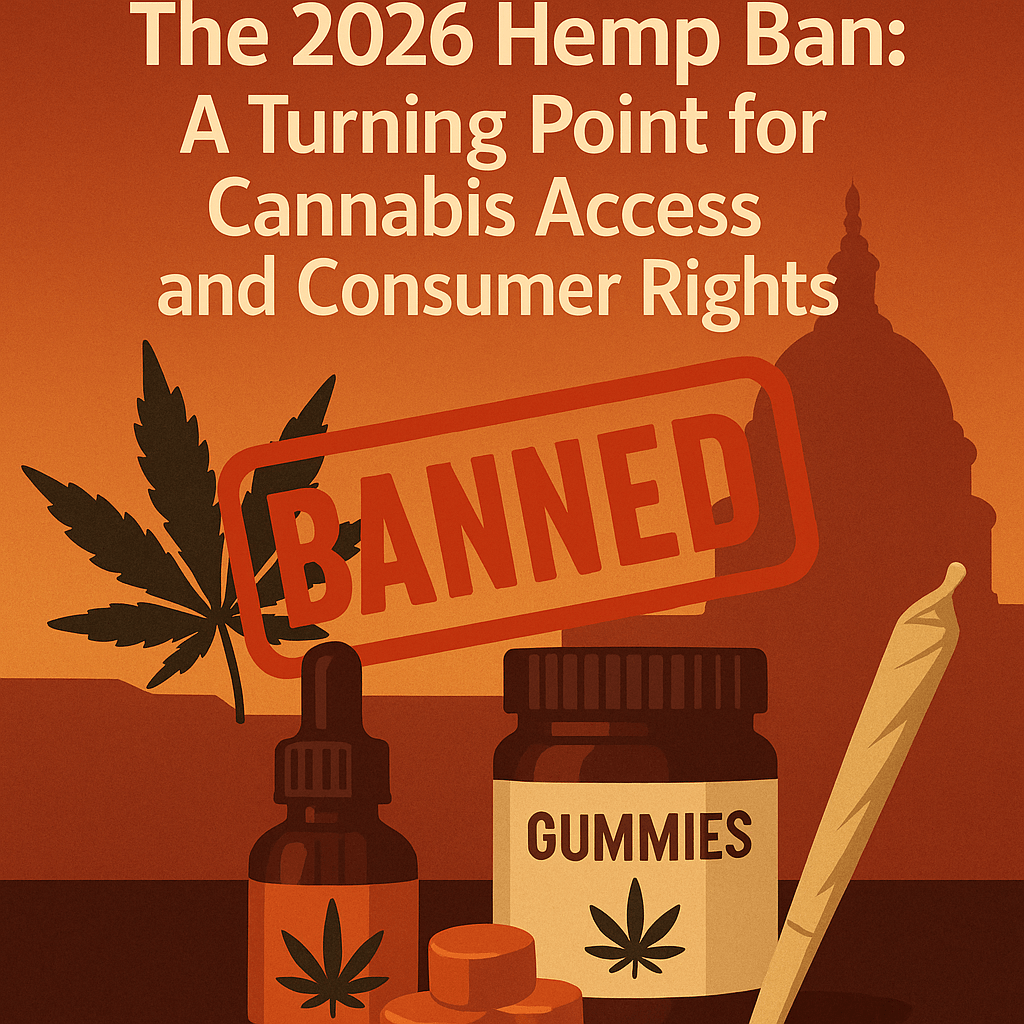
The 2026 Hemp Ban: A Turning Point for Cannabis Access and Consumer Rights
The cannabis industry stands at a crossroads. Federal legislation signed in November 2025 has set the stage for sweeping restrictions on hemp-derived cannabinoid products, with full enforcement beginning November 2026. For consumers who’ve built relationships with trusted brands and reliable products, this represents more than regulatory adjustment—it’s a fundamental challenge to market access and the freedoms we’ve only recently begun to reclaim.
Legal Disclaimer
This content serves educational and informational purposes exclusively. It does not constitute legal, medical, or professional advice of any kind. Information presented reflects federal legislation current as of December 2025 and remains subject to revision. Cannabis and hemp regulations differ substantially across state lines and local jurisdictions. Moon Men makes no medical claims regarding cannabis products. Consult qualified healthcare providers before incorporating cannabis into your wellness routine, and verify local regulations governing cannabis possession and consumption in your area.
At Moon Men, we’ve established our brand identity around authenticity, innovation, and genuine connection with the cannabis community. We’re committed to delivering products that reflect rigorous standards—comprehensive third-party laboratory analysis, detailed cannabinoid profiles, transparent terpene documentation, and unwavering quality control. This regulatory shift extends beyond hemp sector concerns; it challenges the foundation of consumer autonomy, entrepreneurial innovation, and the legitimate cannabis marketplace we’ve collectively built through years of advocacy and education.
Silence serves no one. Whether you depend on these products for daily wellness, cultivate hemp as your profession, or simply champion rational policy over reflexive prohibition—your participation matters. Let’s examine what’s unfolding, why it demands attention, and crucially, how unified action can reshape outcomes.
Decoding the 2026 Hemp Ban
The provisions emerged within the Continuing Appropriations Act, receiving presidential signature on November 12, 2025. Rather than transparent legislative debate or independent consideration, these extensive restrictions materialized within emergency government funding measures—a procedural approach that blindsided industry participants and end users alike.
The Regulatory Transformation
The 2018 Farm Bill legitimized hemp cultivation and commerce, establishing a clear definition: cannabis containing 0.3% Delta-9 THC or less by dry weight. This framework enabled legal hemp-derived offerings including CBD formulations, Delta-8 THC products, and THCA flower. The new federal language fundamentally restructures these parameters with limitations so restrictive that industry analysts project elimination of roughly 95% of existing hemp-derived inventory.
Key federal restrictions now include:
Total THC Measurement Protocol: Federal law now calculates total tetrahydrocannabinols post-decarboxylation (upon heating), abandoning the previous Delta-9 THC-specific standard. THCA—which thermally converts to THC during consumption—now contributes to legal thresholds, effectively eliminating what advocates termed the “THCA pathway.”
0.4 Milligram THC Ceiling: Hemp-derived formulations cannot exceed 0.4 milligrams total THC per container. For context, contemporary hemp gummies typically deliver 5-25mg THC per unit, while infused beverages commonly contain 5-10mg per serving. This ceiling renders virtually all current products non-compliant.
Prohibition of Synthetic and Converted Compounds: Cannabinoids synthesized or manufactured external to plant biology—including Delta-8 THC, Delta-10 THC, HHC, and THCP—face explicit prohibition. These molecules typically originate through chemical conversion of CBD isolate.
Intermediate Material Constraints: In-process hemp extracts and intermediate formulations exceeding revised THC thresholds can no longer transfer through hemp regulatory channels when destined for consumer markets.
Implementation Schedule
Full enforcement activates November 12, 2026, establishing a twelve-month transition window. The FDA must publish naturally-occurring cannabinoid registries and define critical terminology like “container” within 90 days post-enactment. Beyond the November 2026 deadline, non-compliant products face potential enforcement under federal Controlled Substances Act provisions.
Cascading Consequences
These legislative changes transcend Washington policy discussions. They signal a paradigm shift rippling through communities, commercial enterprises, and millions of Americans who’ve integrated legal hemp-derived products into their routines.
Economic Disruption
Since 2018, the hemp sector has matured into substantial economic infrastructure, with market valuations ranging between $28-30 billion annually. This ecosystem sustains employment for over 300,000 individuals across cultivation, extraction, retail operations, and logistics networks. States lacking recreational cannabis frameworks—including Kentucky, Texas, and Utah—witnessed particularly vigorous hemp market expansion.
New restrictions force businesses to confront:
- Revenue elimination across product categories representing dominant market share
- Contractual illegality triggers within leases, financing arrangements, and vendor agreements
- Termination of banking relationships and payment processing as financial institutions withdraw exposure
- Immediate IRS Section 280E taxation application, eliminating standard business expense deductions for Schedule I substance handling
Consumer Marketplace Contraction
Millions residing in states without recreational cannabis programs have accessed cannabinoids for wellness applications, stress management, and quality of life enhancement through hemp-derived channels. The ban eliminates this access immediately, leaving substantial populations without compliant alternatives. Even full-spectrum CBD formulations—containing trace THC quantities and valued for synergistic cannabinoid interactions—face probable illegality under revised restrictions.
Policy Contradiction
The ban amplifies cannabis policy’s inherent contradictions. Hemp products transitioning from legal to prohibited status overnight coexist with marijuana’s federal prohibition alongside state-level legalization across most jurisdictions. This generates confusion among law enforcement agencies, consumers, and businesses navigating perpetually shifting regulatory terrain.
Forces Behind the Ban
Understanding advocacy sources for this prohibition—and underlying motivations—illuminates competing interests shaping cannabis policy trajectories.
The Coalition Architecture
The ban attracted support from multiple influential constituencies:
Alcohol Industry Interests: As hemp-derived beverage formulations captured market share, prominent alcohol trade organizations submitted Congressional correspondence advocating for hemp-based THC product elimination. With alcohol consumption trending downward recently, partially attributable to cannabis alternative emergence, the alcohol sector perceives hemp products as direct marketplace competition.
State-Licensed Cannabis Operators: Segments within regulated marijuana industries endorsed the ban, characterizing unregulated hemp offerings as unfair competition undermining businesses subjected to rigorous state licensing protocols, testing mandates, and taxation structures.
Prohibitionist Legislative Voices: Politicians including Senator Mitch McConnell framed the ban as youth protection necessity, citing hemp product availability through gas stations and convenience retail. Critics counter that age verification enforcement and responsible regulatory frameworks would prove more effective than blanket prohibition.
The Fundamental Miscalculation
The ban conflates negligent operators with responsible enterprises. Rather than establishing rational frameworks addressing age verification, testing standardization, and labeling transparency, the legislation imposes universal prohibition. This approach penalizes legitimate companies investing in quality assurance, transparency, and consumer protection while inadequately addressing youth access concerns or untested product circulation that ostensibly motivated the ban.
Why Quality Standards Matter Now
At Moon Men, our foundation rests on quality obsession, radical transparency, and authentic consumer relationships. We champion products meeting exceptional standards.
Our Quality Philosophy
Independent Laboratory Verification: Every product undergoes certified third-party laboratory analysis ensuring precise cannabinoid and terpene documentation
Radical Transparency: Complete testing documentation and comprehensive product intelligence on every package
Curated Excellence: Deliberate product selection prioritizing safety consistency and user experience
Regulatory Adherence: Complete compliance with all applicable state and federal mandates
The hemp ban underscores why this quality commitment matters profoundly. As regulatory landscapes transform, consumers require trustworthy brands—companies elevating safety, transparency, and reliable quality above corner-cutting or loophole exploitation.
Advocacy Pathways: Your Participation Counts
This ban isn’t predetermined. The twelve-month implementation window creates critical opportunities for advocacy, education, and political pressure. Historical precedent demonstrates that organized consumer mobilization influences policy outcomes, and the cannabis community has repeatedly proven its capacity for effective coordination.
Congressional Engagement
Your elected representatives require direct constituent input. Personal narratives carry substantial weight—whether you’re a business owner whose enterprise depends on this sector, a hemp farmer, or a consumer relying on these products.
Congressional contact methodology:
- Locate your representative via house.gov and senators through senate.gov
- Direct phone communication to district offices—calls generate greater impact than digital correspondence
- Share your personal experience and articulate how this ban affects your circumstances
- Request support for the American Hemp Protection Act of 2025 (Rep. Nancy Mace’s legislation repealing hemp provisions)
- Oppose analogous hemp prohibition language in future legislative vehicles
Essential messaging elements:
- Advocate for intelligent regulation over blanket prohibition
- Emphasize responsible business support for age restrictions and testing requirements
- Document economic impact within your community
- Note that prohibition fails to address stated concerns regarding youth access or bad actors
Industry Advocacy Organization Participation
National organizations coordinate legal challenges and lobbying infrastructure:
U.S. Hemp Roundtable: The sector’s premier advocacy entity, engaging Congressional allies to build political opposition momentum. Visit their Action Center for immediate engagement opportunities.
American Healthy Alternatives Association (AHAA): Mobilizing grassroots advocacy, coordinating with legislative allies, and funding legal strategies. Their Action Center provides template correspondence for representative outreach.
Membership investment and contributions fund lobbying operations, legal strategy development, and grassroots campaigns. These organizations command expertise and political access necessary to influence policy trajectories, but require financial backing and member engagement for effectiveness.
Support Responsible Market Participants
Exercise purchasing power by supporting companies committed to quality, transparency, and consumer protection. Purchase through licensed, regulated channels prioritizing third-party testing and explicit labeling. When you support responsible operators like Moon Men, you’re advocating for the industry model we collectively envision—one founded on standards, not shortcuts.
Future Scenarios
Coming months determine hemp’s trajectory in America. Several outcomes remain plausible:
Legislative Reversal
Congress could enact legislation repealing or modifying hemp provisions before enforcement. Rep. Nancy Mace has introduced the American Hemp Protection Act of 2025, which would simply repeal Section 781 of the appropriations legislation. Success requires lawmakers receiving overwhelming constituent opposition.
Regulatory Interpretation
FDA’s forthcoming guidance defining cannabinoid classifications and “container” parameters could provide interpretive flexibility regarding law application and enforcement. However, industry experts express skepticism that regulatory guidance can overcome statutory limitations.
Judicial Intervention
Multiple legal challenges appear likely, arguing the ban exceeds Congressional authority, violates due process protections, or conflicts with state agricultural and commercial sovereignty. These challenges could delay implementation or invalidate ban portions, though they require time and face uncertain resolution.
Common Questions Addressed
Q: Does this prohibition affect state-legal recreational or medical cannabis programs?
A: No, the ban specifically targets hemp-derived products marketed under 2018 Farm Bill frameworks. State-licensed cannabis dispensaries operating under medical or recreational authorization aren’t directly impacted by these federal hemp restrictions. However, the ban highlights ongoing federal cannabis policy tensions.
Q: Will CBD products remain legal beyond November 2026?
A: Product-dependent. CBD formulations containing 0.4 milligrams or less total THC per container would maintain legal status. However, this eliminates most full-spectrum CBD products containing elevated THC levels often preferred by consumers for entourage effects. Broad-spectrum and CBD isolate formulations with minimal THC may remain available if meeting strict thresholds.
Q: What distinguishes hemp from marijuana?
A: Both represent Cannabis sativa plant varieties. The primary legal distinction centered on THC content—hemp defined as cannabis containing 0.3% Delta-9 THC or less by dry weight, while marijuana exceeded that threshold. However, plants share botanical classification. The new ban restructures this definition by measuring total THC (including THCA) and imposing per-container limits rather than dry-weight percentages.
Q: Why does this ban differ from previous hemp restriction attempts?
A: Previous attempts to close the “hemp loophole” failed because they emerged as standalone legislation subject to discrete debate and voting. This ban succeeded through embedding within emergency government funding legislation during a government shutdown crisis. Lawmakers faced pressure to restore government operations, complicating opposition to specific provisions without derailing entire packages.
Q: How do I identify cannabis brands prioritizing quality and safety?
A: Seek brands providing comprehensive third-party laboratory testing results, explicitly labeling cannabinoid and terpene profiles, operating under state licensure, and demonstrating transparency regarding cultivation and extraction methodologies. Legitimate companies willingly share testing protocol information, sourcing practices, and quality control measures. Avoid products featuring vague labeling, absent batch-specific testing documentation, or claims appearing too good to be true.
Final Thoughts
The 2026 hemp ban represents a critical juncture for American cannabis policy. We can accept prohibition masquerading as regulation, or we can unite and demand sensible approaches prioritizing consumer safety, business sustainability, and personal autonomy.
The next twelve months will determine whether an entire industry vanishes or whether rational policy prevails. Your voice, your advocacy, and your support for responsible businesses create the difference.
This transcends hemp specifically. It’s about whether we advance toward evidence-informed policy and regulated markets, or whether we regress to failed prohibition paradigms. It’s about protecting hundreds of thousands of livelihoods, billions in economic activity, and millions of consumers depending on legal cannabis product access.
At Moon Men, we believe in fighting for what’s right. We believe in premium legal cannabis, cultivated deliberately, tested rigorously, and delivered to consumers deserving transparency and trust. Utilize your resources—your voice, your ballot, your purchasing decisions—to support the future we’re building collectively.
The ban may activate in November 2026, but efforts to overturn it begin immediately. Together, we can ensure quality legal cannabis remains accessible to everyone requiring it.
Final Legal Disclaimer
Nothing in this article should be interpreted as medical advice. Cannabis affects individuals differently, and you should consult qualified healthcare professionals before using any cannabis products. This article provides information about federal legislation and advocacy opportunities but does not constitute legal advice. Cannabis and hemp laws vary significantly by jurisdiction and remain subject to change. Always verify current laws in your location before purchasing or using cannabis products. Moon Men makes no medical claims about cannabis products and does not suggest that cannabis treats, cures, or diagnoses any medical conditions.